
Financial knowledge your people can put to work.
Know-How is three things built on each other. A library of 697 practitioner-written tutorials across twelve channels of banking and finance. KHX, the platform your people learn on. And an AI layer that answers questions from that library and nothing else.
The library, the platform, and the AI layer in one overview.
Three parts, three different jobs.
Buyers often hear the three names as one product, which makes it hard to say what they're paying for or which part solves the problem in front of them. Each one can be bought and deployed on its own.
Know-How
697 tutorials and 65+ hours of video across twelve banking and finance channels, rewritten and extended every quarter by practitioners. This is the subject-matter knowledge.
KHX
The learner-facing hub: curated plans by career goal, playlists, progress tracking, and completion evidence. Teams who prefer their own LMS take the content there instead.
Know-How Intelligence
A conversational agent for corporate financial education that draws answers from approved sources and cites them, reaching learners in Teams, Slack, and the systems they already use.
Learning that starts with the role.
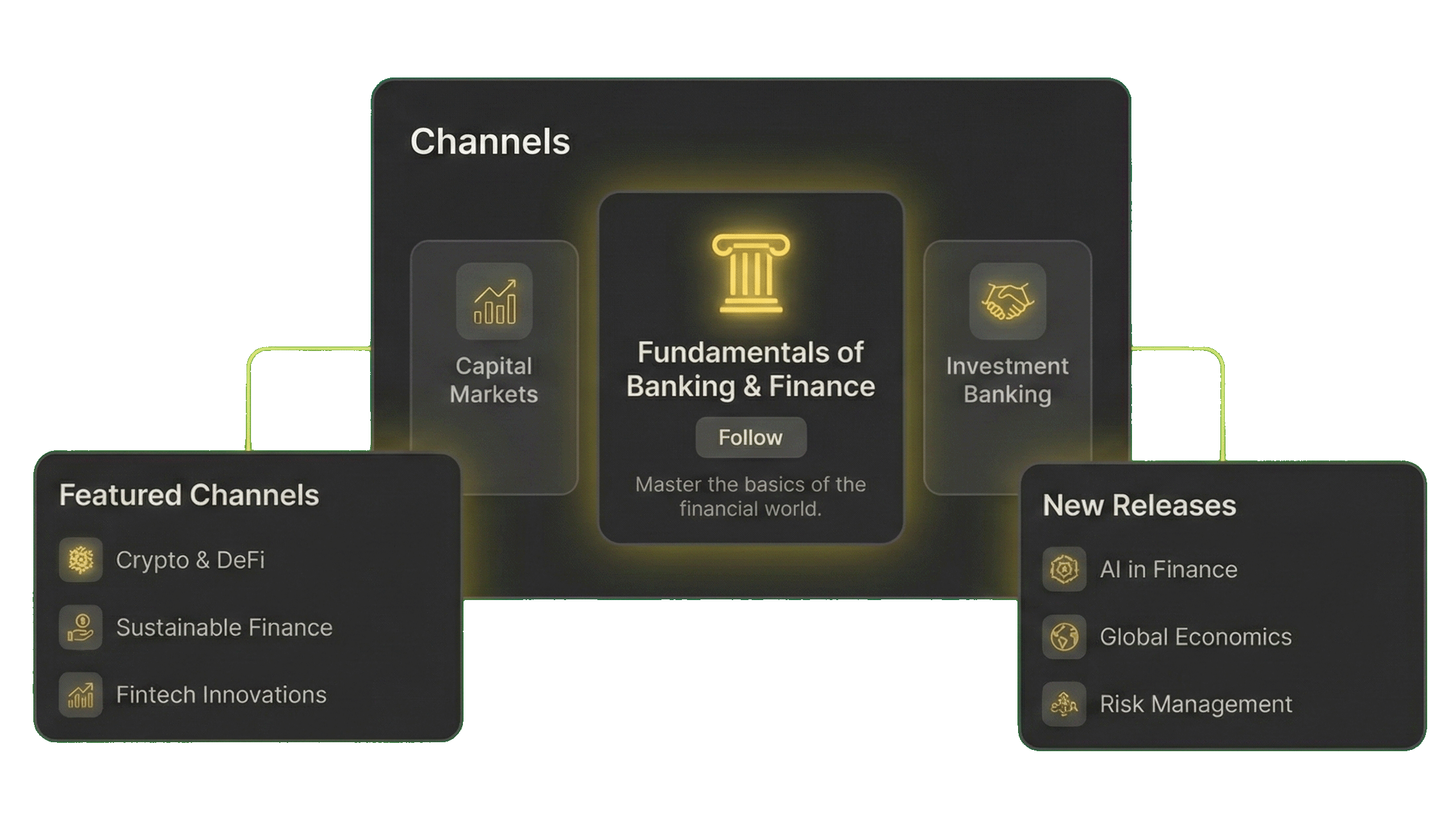
Choose the channels that matter to your work
Learners follow relevant channels across banking and finance, from fundamentals to capital markets, risk, ESG, AI and FinTech, and regulation. Their choices help personalize the content they see.
Build a path from what you know
Adaptive, conversational assessment identifies knowledge gaps and informs a personalized learning path. Spaced reinforcement helps learners retain what they've learned, with access through connected work and learning systems.
Twelve channels, refreshed quarterly
Explore 697 tutorials and 65+ hours of video written by financial-services practitioners, 593 learning hours in total.
▶ Fundamentals of Banking and Finance78 · 55h
How money, markets, and institutions fit together, from balance sheets to payment systems.
Retail and corporate banking basics, financial statements, interest rates, FX, the payments system, and the role of regulators.
Build the financial knowledge new joiners need for conversations with clients and colleagues.
▶ Investment Management47 · 41h
The buy side, from investment mandates and portfolio construction to performance measurement.
Asset classes, portfolio theory, benchmarks and attribution, fund structures, and fee models.
Explain investment mandates and distinguish the measures used to assess portfolio performance.
▶ Capital Markets198 · 167h
Our most extensive channel covers financial instruments, structures, and the mechanics of trading.
Equities, fixed income, derivatives, structured products, securitization, collateral, clearing, and settlement.
Develop the knowledge to understand positions and discuss pricing, hedging, and trade processes.
▶ Private Wealth Management21 · 17h
The knowledge behind advice to individuals and families, where tax, structure, and relationships all matter.
Suitability, wealth structuring, trusts, cross-border considerations, and portfolio advice for private clients.
Bring a stronger understanding of suitability and wealth structures to client conversations.
▶ Investment Banking41 · 33h
How deals progress from origination through execution.
M&A, ECM and DCM, valuation, due diligence, deal documentation, and the syndicate process.
Prepare analysts to understand the deal sequence and their responsibilities within it.
▶ Retail and Consumer Banking41 · 35h
Everyday banking products and the conduct requirements that shape how they're offered.
Checking accounts, mortgages, consumer credit, deposit products, digital channels, and fair treatment obligations.
Help branch and contact center teams explain core products and recognize when to seek guidance.
▶ Corporate Banking37 · 37h
Banking business clients, with credit judgment at the center of the relationship.
Credit analysis, working capital, trade finance, cash management, covenants, and loan documentation.
Strengthen the knowledge relationship managers bring to credit discussions and financing decisions.
▶ Securities Services9 · 9h
How assets are held, serviced, and settled.
Custody, fund administration, asset servicing, corporate actions, and securities lending.
Help operations teams understand how their work affects the wider transaction process.
▶ Banking Risk Management79 · 76h
The risks banks manage and the methods used to measure and govern them.
Credit, market, liquidity, operational, and model risk, plus capital adequacy, stress testing, and the three lines of defense.
Develop a shared risk vocabulary across business and control functions.
▶ Sustainability and ESG46 · 32h
Sustainable finance, from investment decisions to disclosure and reporting.
Climate risk, ESG integration, disclosure regimes, transition finance, and greenwashing risk.
Assess the evidence behind ESG claims and understand the questions clients and regulators may raise.
▶ AI and FinTech45 · 34h
How technology is changing financial services and the decisions it brings to each role.
AI and machine learning in finance, digital assets, payments innovation, open banking, cloud, and cyber risk.
Recognize opportunities for new technology and the risks that need human judgment and oversight.
▶ Regulation and Compliance55 · 57h
The regulatory obligations that shape financial-services work.
Financial crime and AML, conduct, market abuse, data protection, prudential regulation, and the supervisory process.
Apply regulatory knowledge to everyday decisions and recognize when an issue needs escalation.
KHX, where the learner meets the library.
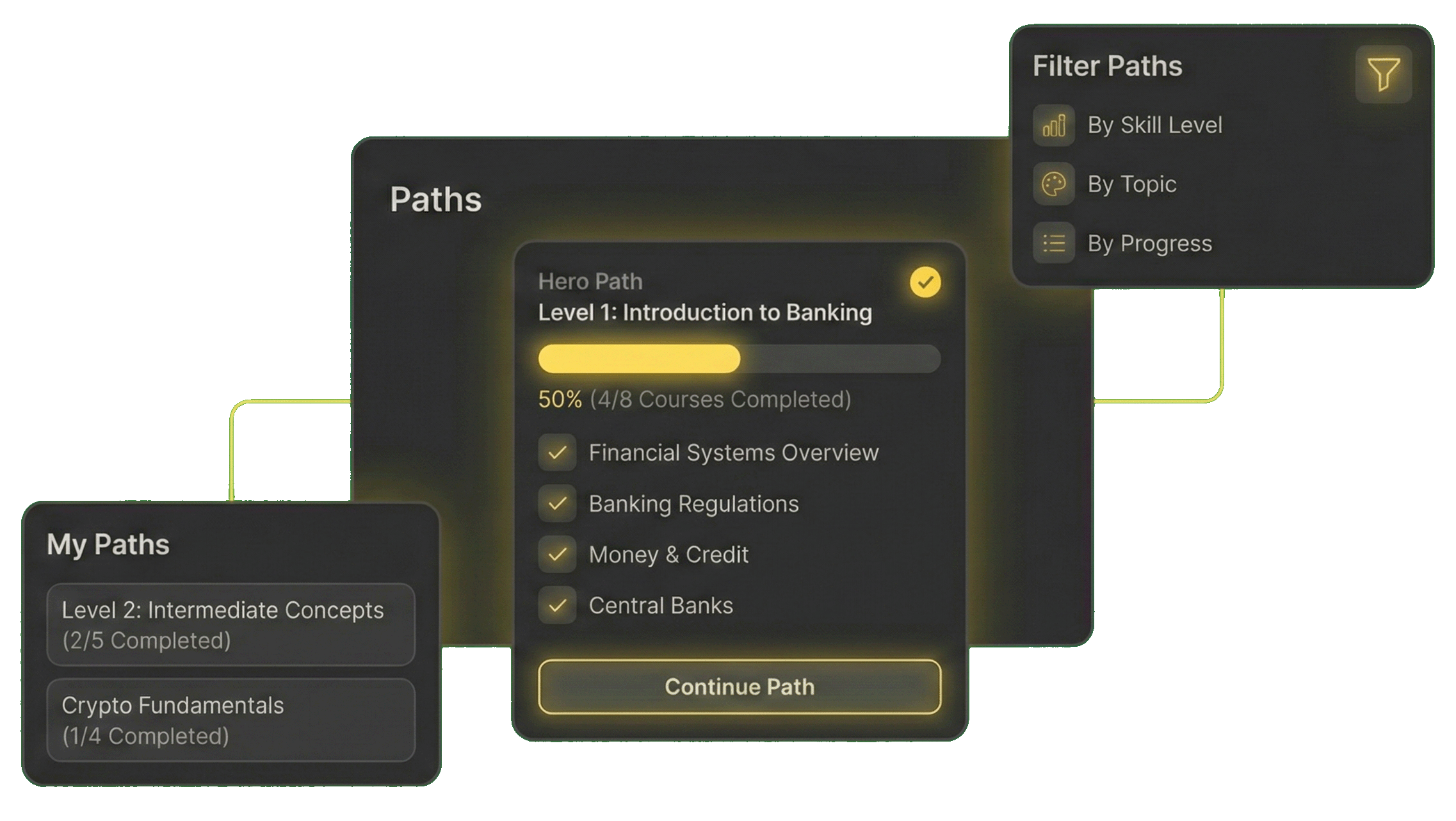
A library of 697 tutorials is a problem as well as an asset. Someone has to decide what a given person should watch this month. KHX makes that decision navigable. It presents learning by interest, role, and career goal, and it keeps the record of what was completed.
Learning aligned to the role
Content lines up with the learner's interests, their role, and where they want their career to go.
Curated learning plans
Routes built for financial services roles rather than assembled from whatever is in the catalog.
Content, playlists, and progress
Learners work at their own pace and pick up where they left off, with progress tracked as they go.
Evidence of completion
Track achievements and evidence completion, which is what an L&D team needs when a manager or a regulator asks what a person has actually done.
KHX is an option, not a requirement
A team with an established assignment and reporting process in its own LMS keeps it and adds the finance content. Licensing covers the full library or only the tutorials you pick.
Know where the answer comes from.
Approved content
The agent draws on your approved library and links answers to their sources.
Traceable answers
Source lineage and answer logs support review by your teams.
Enterprise security
Review SSO and security requirements with us as part of implementation.
An 8 to 12 week rollout
The AIMI method takes you through assessment, implementation, monitoring, and improvement.
Six agents support the learning experience.
Learners ask questions through Know-How Intelligence. Behind it sit five more agents covering skills mapping, assessment, reporting, administration, and content production, each one tailoring learning to the person and their role.
Know-How Intelligence
Find answers and personalized support grounded in approved content, with source citations. Access it through Teams, Slack, email, or the web.
Skills Intelligence
Identify individual and team skill gaps against the roles you define.
Knowledge Intelligence
Assess understanding through adaptive, conversational questions.
Insight Agent
Bring engagement, knowledge gaps, and learning outcomes into a shared reporting view.
Operations
Handle enrollment, learning records, and the reporting your administrators would otherwise assemble by hand.
Studio
Produce and adapt learning content for your own policies and products, drawing on Intuition's 40+ years in financial-services learning.
One library, read three ways.
The library is the basis for all of it. KHX gives it a learner-centric home. The agents extend its reach into the places people work. Run together, a question asked in Teams and a plan assigned in KHX point at the same 697 tutorials, so the answer a learner gets and the learning they're assigned agree with each other.
Supplies the knowledge
And the source that every answer and every citation resolves back to.
Supplies the path
The progress record and the completion evidence for an individual learner.
Supplies the answer
At the moment of the question, along with the record of what was asked.
What to settle before the AI layer goes live.
Source grounding and citation are design choices, not proof that every answer is right. Put these five questions to the implementation review, using your own intended use case rather than a demonstration script.
Source and version
Can the learner open the material supporting an answer, and see which version of it they're reading?
Quarterly replacement
When a release replaces a tutorial, what happens to answers that cited the old one?
The gap
What does the agent do when the approved material doesn't answer the question?
Logs and retrieval
Which prompts, responses, and review actions are logged, who can retrieve them, and for how long?
Permissions
How do permissions work when your own policies sit alongside the library and teams hold different access?
Accreditation and the training record.
Know-How tutorials are accredited by leading international continuing education bodies, and KHX tracks achievements and evidences completion. Those two facts serve different people.
Credit toward a designation
Completion records and certificates that count toward a professional designation, for the courses the body recognizes.
Evidence of who did what
A record of who completed which version of which tutorial, which is what an internal audit or an examination request asks for.
Confirm eligibility per course
Name the professional body, the jurisdiction, and the exact courses, and we'll confirm the applicable credit and the certificates your people receive.
From assessment to implementation with AIMI.
Discovery and analysis
Map roles and organizational structure, review your existing content, and agree on the measures of success before configuration begins.
Build and deploy
Configure the agents, role mappings, and personalization. Connect agreed learning and identity systems, then test the experience with learners.
Track and measure
Review engagement, answer rates, agent performance, and learning effectiveness against the baseline established in phase one.
Optimize and evolve
Refine personalization and recommendations, add content sources, and extend access to further roles and departments.
Implementation is shaped around your organization. Your structure, role definitions, content, and KPIs guide the configuration. A typical rollout takes 8 to 12 weeks, with scope and timing agreed during discovery.
Start with one team, one role, or one regulation.
Bring five questions your people ask. We'll use them to explore Know-How and discuss the scope, measures, and effort involved in a pilot.
Book a walkthroughHow is this different from our current LMS?
Know-How provides financial-services content and AI-assisted learning that can connect with your existing learning systems. We'll review the integration options with your team.
Can we blend our own content?
Yes. SCORM, xAPI, video, and documents can sit alongside the Know-How tutorials. We'll agree which sources the agent can use and how they're cited.
How long does implementation take?
A typical rollout takes 8 to 12 weeks. The timeline depends on your content, integrations, and onboarding needs.
What does it cost?
Pricing depends on learner numbers and the modules you license. We can discuss the scope in a walkthrough and provide a written proposal.
Continuing professional education
Know-How includes accredited learning that can help your people maintain professional qualifications. The eligible content and reporting requirements vary by professional body.
Online learning records can support continuing education requirements. Where a body requires certificates or reporting from Intuition, we'll explain the process and confirm what's available for your learners.
Ask about your accreditation requirementsAccreditations
Ask us which Know-How content qualifies for your professional body's requirements.
Know-How Platform Overview
Know-How is three things: a tutorial library, the KHX platform the library sits in, and an AI layer that answers only from that library. The overview takes them one at a time, shows what release v80 changed, and sets out what a rollout involves.
Inside the overview
- The library: 697 tutorials, 593 hours, twelve channels
- The platform: KHX, or the LMS you already run
- The AI layer: cited answers, and six agents
- Five control questions, accreditation, and a four-phase rollout
Get the overview
Tell us where to send your copy.
We'll use your details to send this resource.